
📌 Introduction
The transition to Software-Defined Vehicles (SDVs) is revolutionizing how vehicles are designed, developed, and maintained. At the core of this transformation is the shift from traditional distributed E/E architecture to a more centralized and Zonal Architecture. This architectural evolution is essential for enabling greater software control, over-the-air (OTA) updates, and scalability in modern vehicles.
1️⃣ What is a Software-Defined Vehicle (SDV)?
An SDV (Software-Defined Vehicle) is a car where most functionalities are controlled by software rather than traditional hardware-dependent ECUs.
🔹 Key SDV Characteristics:
- Centralized Software Control: Vehicle functions (ADAS, Infotainment, Powertrain) are primarily controlled by software.
- Over-the-Air (OTA) Updates: Continuous software enhancements without requiring physical hardware modifications.
- Cloud Connectivity & AI Integration: Software updates, diagnostics, and optimizations happen remotely.
- Decoupling Hardware & Software: Software can be updated or modified independently from hardware, improving vehicle longevity.
2️⃣ What is Zonal Architecture?
Zonal Architecture is an evolution of traditional distributed E/E architectures, designed to simplify vehicle wiring, optimize ECU placement, and improve performance.
🔹 Key Features of Zonal Architecture:
- ECU Consolidation: Reduces the number of ECUs by integrating functions into high-performance Zonal Controllers.
- Reduced Wiring Complexity: Instead of direct ECU-to-ECU connections, zonal controllers aggregate signals and transmit them over high-speed networks.
- Ethernet Backbone Integration: Uses Automotive Ethernet (AVB/TSN) for high-speed, low-latency communication.
- Functional Domains Managed by Zones: Critical vehicle functions are handled within specific zonal controllers rather than multiple independent ECUs.
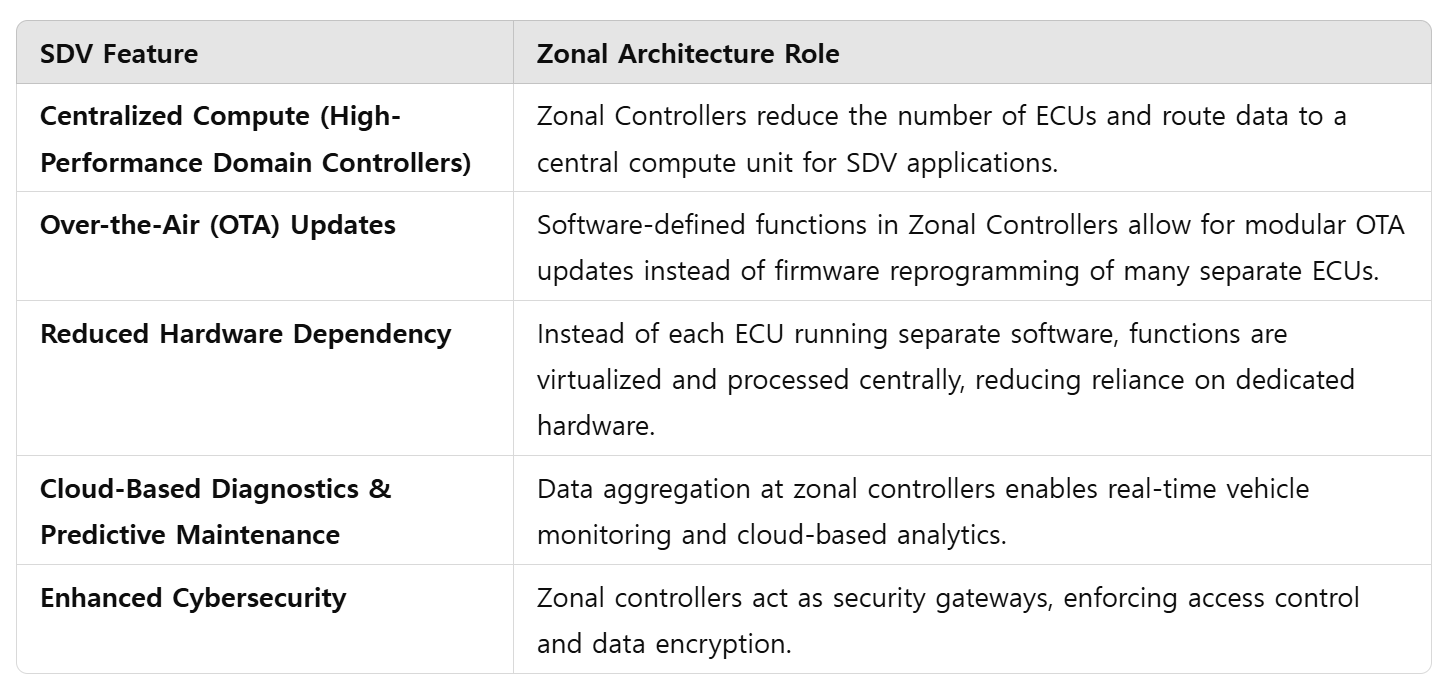
3️⃣ How SDV and Zonal Architecture Are Interconnected
🚗 Zonal Architecture is the foundation that enables SDV implementation.

🔗 SDV Requires Zonal Architecture for Scalability
- Without Zonal Architecture, SDVs would struggle with legacy ECU-based limitations (high wiring complexity, update challenges, latency issues).
- Zonal Controllers provide a structured way to scale SDV applications across different vehicle segments and models.
4️⃣ Transition from Traditional ECU-Based to SDV-Ready Zonal Architecture

5️⃣ Conclusion: Zonal Architecture is the Backbone of SDV
✅ Zonal Architecture is not just an optimization; it is a necessity for SDV implementation.
✅ It allows vehicles to transition from hardware-centric designs to software-driven mobility solutions.
✅ By reducing wiring complexity, centralizing compute power, and enabling OTA updates, Zonal Architecture unlocks true SDV potential.
🚀 Future Outlook: As SDVs become more prevalent, Zonal Architecture will evolve further, integrating AI-based decision-making, cloud-native vehicle management, and even vehicle-to-everything (V2X) communication, paving the way for next-generation autonomous and connected vehicles.

